Why Databricks Is Booming for Data Engineers
Apr 29, 2026
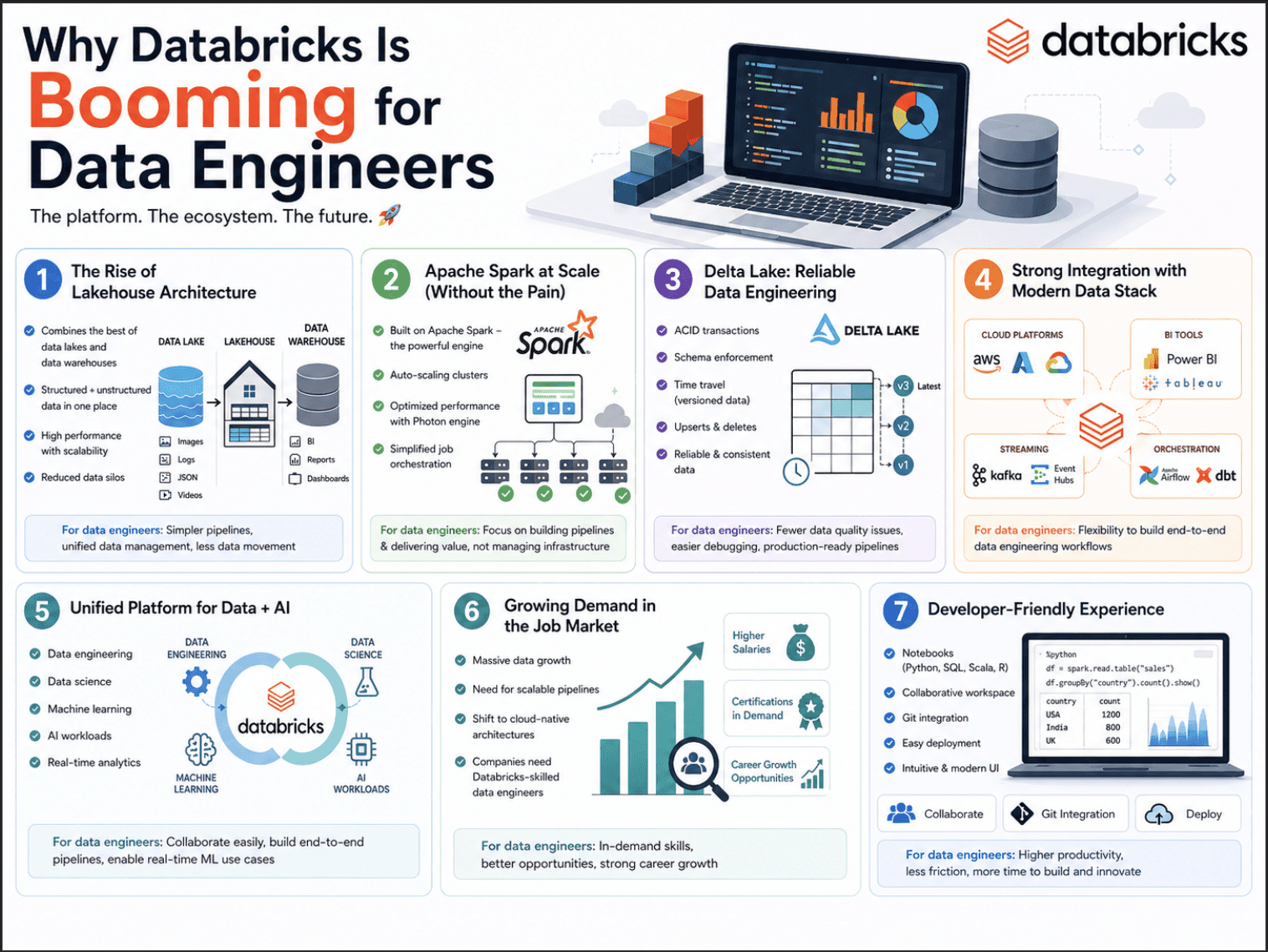
In the rapidly evolving world of data engineering, one platform has consistently stood out over the past few years—Databricks. From startups to Fortune 500 companies, organizations are increasingly adopting Databricks as their go-to solution for data processing, analytics, and AI. But what’s driving this surge in popularity?
Let’s break down why Databricks is booming—and why data engineers are at the center of this transformation.
1. The Rise of Lakehouse Architecture
Traditionally, companies had to choose between:
Data warehouses (structured, fast analytics)
Data lakes (cheap storage, flexible but messy)
Databricks introduced the Lakehouse Architecture, combining the best of both worlds:
Structured + unstructured data in one place
High performance with scalability
Reduced data silos
For data engineers, this means:
Simpler pipelines
Unified data management
Less time spent moving data between systems
2. Apache Spark at Scale (Without the Pain)
Databricks is built on Apache Spark, one of the most powerful distributed processing engines.
But here’s the key advantage:
Databricks removes the complexity of managing Spark infrastructure.
Data engineers benefit from:
Auto-scaling clusters
Optimized performance (Photon engine)
Simplified job orchestration
Instead of worrying about cluster tuning, engineers can focus on building data pipelines and delivering value.
3. Delta Lake: Reliable Data Engineering
One of the biggest pain points in data engineering is data reliability.
Databricks solves this with Delta Lake, which brings:
ACID transactions
Schema enforcement
Time travel (versioned data)
This transforms messy data lakes into trustworthy data platforms.
For engineers, this means:
Fewer data quality issues
Easier debugging
Production-ready pipelines
4. Strong Integration with Modern Data Stack
Databricks fits seamlessly into the modern ecosystem:
Cloud platforms (AWS, Azure, GCP)
BI tools (Power BI, Tableau)
Orchestration tools (Airflow, dbt)
Streaming (Kafka, Event Hubs)
This flexibility makes it a central hub for data engineering workflows.
5. Unified Platform for Data + AI
Databricks is not just for data engineering—it’s a unified platform for:
Data engineering
Data science
Machine learning
AI workloads
This convergence is powerful.
Data engineers can:
Collaborate easily with data scientists
Build end-to-end pipelines
Enable real-time ML use cases
6. Growing Demand in the Job Market
Companies are actively looking for Databricks-skilled data engineers.
Why?
Massive data growth
Need for scalable pipelines
Shift to cloud-native architectures
As a result:
Databricks skills command higher salaries
Certifications (like Databricks Certified Data Engineer) are gaining traction
Career growth opportunities are expanding rapidly
7. Developer-Friendly Experience
Databricks offers:
Notebooks (Python, SQL, Scala, R)
Collaborative workspace
Git integration
Easy deployment
This improves productivity and reduces friction in development.
Final Thoughts
Databricks is booming because it solves real-world data engineering challenges:
Complexity
Scalability
Reliability
Collaboration
For data engineers, it represents a shift from managing infrastructure to delivering insights and value.
If you’re in data engineering—or planning to enter the field—learning Databricks is no longer optional. It’s becoming a core skill for the future of data.