Ingestion Accelerator (Databricks)
Dec 14, 2024
Project Type: B2B Resource
Project Timeline: September 2024 – December 2024
Client Region: EMEA
Industry: General Product
Context & Objectives
In many enterprise data programs, onboarding new data sources is one of the most time-consuming and error-prone stages of the lifecycle. Each new project often begins with engineers manually setting up ingestion pipelines, defining schema mappings, writing custom transformation logic, and implementing one-off quality checks. Over time, this repetition led to fragmented patterns, inconsistent logic, and significant rework across teams.
The client, a B2B data services organization, faced exactly this challenge. With an expanding ecosystem of APIs, partner databases, and semi-structured file feeds, their Databricks environment was becoming difficult to maintain. Each project required unique handling for formats, SLAs, and quality rules resulting in delayed onboarding, duplication of effort, and varying reliability standards.
Project Goals
Recognizing the inefficiencies caused by repetitive ingestion development, the team set out to build a reusable Ingestion Accelerator, a metadata-driven framework designed to simplify and standardize the way data sources are onboarded into Databricks. The primary goal was to transition from manual, code-heavy ingestion patterns to a config-first approach, where new sources could be added or updated through declarative metadata rather than complex engineering tasks.
This accelerator would serve as a foundational ingestion layer within the organization’s data ecosystem, automating the entire flow from raw data ingestion to transformed and curated outputs across the Bronze, Silver, and Gold medallion layers.
Challenges
As data sources grew in number and diversity, the client’s existing ingestion approach began to show major operational and scalability gaps. The data engineering teams were spending disproportionate time on repetitive, low-value setup tasks instead of focusing on business logic and analytics enablement.
The key challenges that drove the need for an accelerator were:
Fragmented Data Ecosystem
The organization needed to ingest data from a wide range of sources APIs, operational databases, file drops, and streaming feeds. Each source came with its own format, latency expectations, and delivery SLAs. This heterogeneity made it difficult to establish a single, consistent ingestion process.
Repeated Engineering Effort
Similar ingestion logic such as schema extraction, watermarking, and deduplication had to be rebuilt for each project. Teams were often re-implementing the same transformations and quality rules in slightly different ways, leading to inconsistency and wasted effort.
Inconsistent Data Quality and Backfill Logic
Without standardized expectations or controls, teams handled missing data, schema drifts, and reprocessing in ad hoc ways. As a result, downstream analytics often suffered from stale or incorrect data.
Lack of Centralized Governance and Traceability
There was no unified mechanism to manage schema evolution, audit trail capture, or deduplication across environments. Quality issues and ingestion delays were difficult to trace back to their root cause. Furthermore, without strong metadata-driven control, it was challenging to enforce policies, lineage, or cost accountability in a multi-project Databricks environment.
Solution Overview
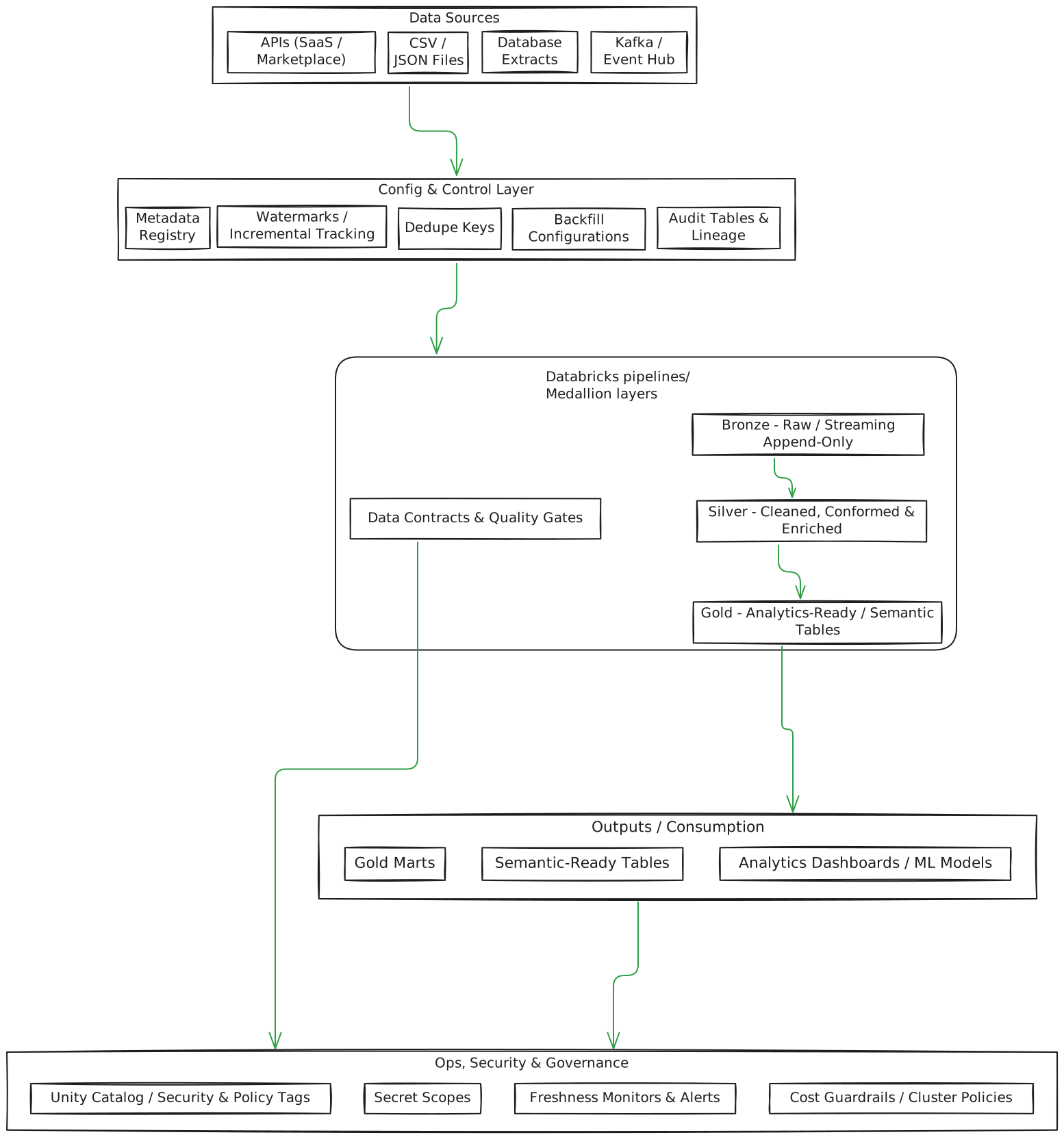
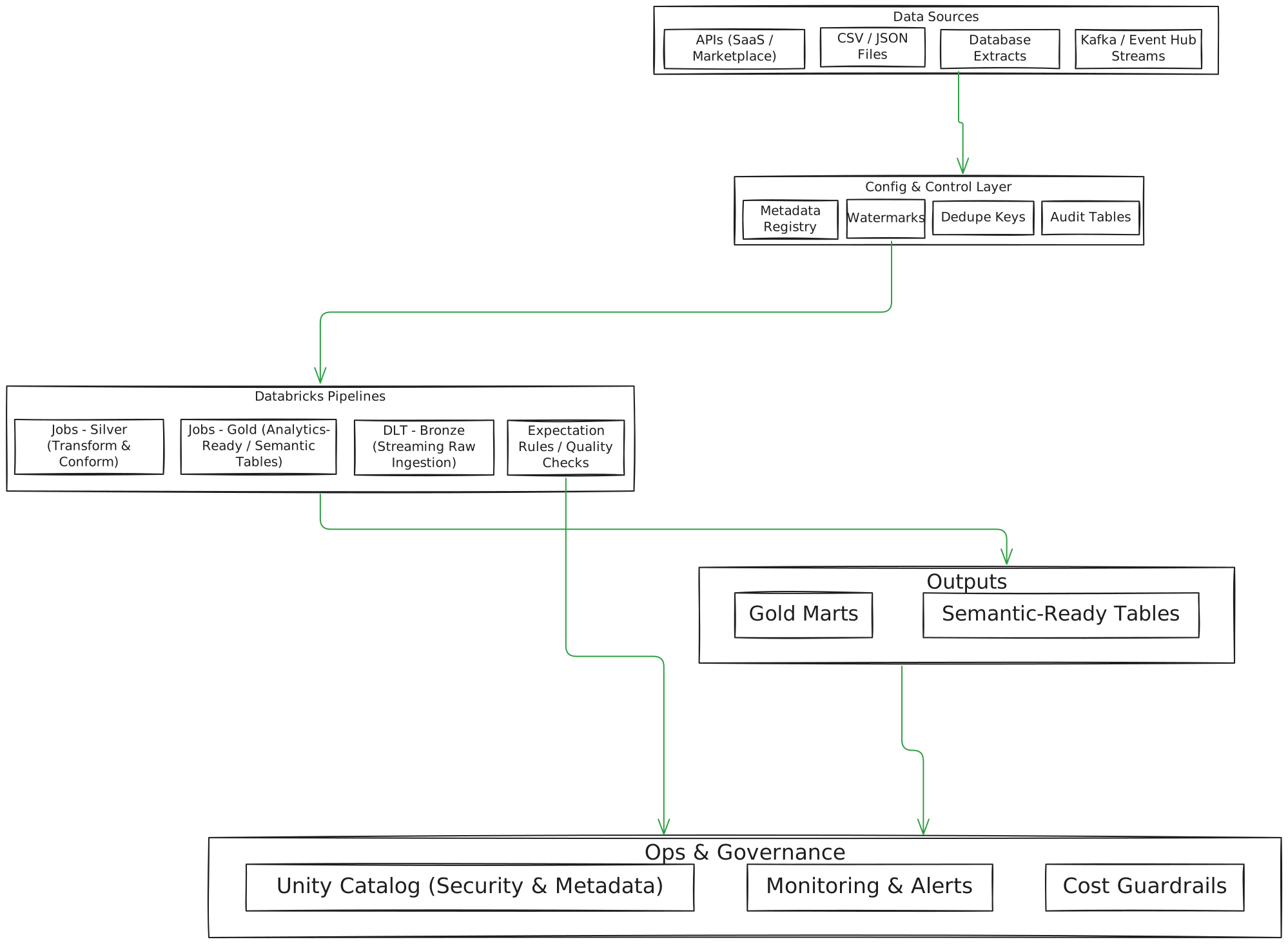
To address the challenges of fragmented sources, repeated engineering effort, and inconsistent data quality, we built the Databricks Ingestion Accelerator, a metadata-driven ingestion framework designed to automate end-to-end data onboarding across the Bronze–Silver–Gold medallion architecture in Databricks. The framework allowed us to standardize ingestion patterns, enforce quality controls, and accelerate delivery across multiple domains while maintaining governance and cost efficiency.
Here’s how we approached each key capability:
Metadata Registry
We created a centralized source registry to act as the single source of truth for every ingestion pipeline. For each data source, we captured essential metadata such as schema hints, deduplication keys, watermark columns, and backfill configurations. By using this registry, we could onboard new sources without writing custom code for each pipeline. The registry allowed us to parameterize pipelines consistently, manage schema evolution, and enforce governance rules across environments.
Parameterized Pipelines
Rather than building separate pipelines for every new source, we developed unified templates that could handle both batch and streaming data. These templates were driven entirely by the metadata registry, allowing us to instantiate pipelines dynamically.
For example, whether a source was a CSV drop, a REST API, or a Kafka stream, the same underlying pipeline logic applied with configurations injected from the registry.
Automated Backfills
Historical data backfills are typically tedious and error-prone, but we automated this process by defining controlled backfill windows in the registry. Pipelines could reprocess historical data, respecting deduplication keys and watermarks. We also included parameterized backfill options, so teams could target specific time windows without impacting ongoing pipelines.
Data Contracts
To guarantee downstream stability, we implemented data contracts that enforced both schema conformity and data freshness at every layer. Pipelines were equipped with automatic checks for column types, required fields, null ratios, and freshness thresholds. If a source failed any of these checks, the system would flag it immediately, preventing flawed data from propagating downstream.
Audit & Observability
We knew that visibility into pipelines is critical for operational reliability, so we built comprehensive audit and observability capabilities. Every pipeline run captured lineage information, processed row counts, errors, and reconciliation metrics. In case of failures, teams could trace issues back to the source or transformation step.
Architecture Overview
Constraints & Non-Functional Requirements
When building the Databricks Ingestion Accelerator, it was not enough to simply focus on functionality, we also had to ensure the framework met enterprise-grade non-functional requirements such as security, reliability, performance, and cost efficiency. These constraints guided the architecture and operational design of the solution.
1. Security & Governance
Data security and governance were top priorities, particularly because pipelines ingested sensitive and enterprise-critical data across multiple domains. We leveraged Unity Catalog to centrally manage access controls, object-level permissions, and policy tags for sensitive data. By embedding governance directly into the pipelines, we were able to enforce consistent policies across all environments, maintain regulatory compliance, and prevent accidental data exposure.
2. Freshness & Latency
Business stakeholders rely on timely data for decision-making. To meet these expectations, we designed the pipelines with layered freshness targets:
Bronze Layer: Near real-time ingestion, capturing raw data as soon as it became available.
Silver & Gold Layers: Scheduled transformations aligned with business Service Level Objectives (SLOs), ensuring downstream analytics and dashboards were updated reliably without unnecessary processing overhead.
3. Reliability & Scale
We anticipated that the ingestion framework would operate across multiple domains, environments, and high-volume sources. To ensure reliability and scalability, we implemented parameterized backfills, enabling replay of historical data when needed.
4. Cost Guardrails
Operating in a cloud or Databricks environment comes with cost considerations. We implemented cost-optimized controls such as:
Cluster sizing policies: Ensuring that each workload used the right resources for its volume.
Concurrency caps: Preventing too many heavy pipelines from running simultaneously and overloading clusters.
Volume-aware backfills: Optimizing reprocessing by dynamically sizing jobs based on historical data volume.
Data Model & Semantics
To ensure the Databricks Ingestion Accelerator produced reliable, consistent, and analytics-ready data, we designed the framework around a config-first, metadata-driven data model. This approach allowed us to treat each source uniformly while preserving flexibility for transformations and business logic.
Config-First Design
Rather than building custom pipelines for every source, we defined each data source through metadata configurations. These configurations included schema hints, watermarks, dedupe keys, and transformations.
By centralizing these definitions, we could onboard new sources rapidly and ensure every pipeline adhered to consistent standards.
Medallion Architecture
To structure data effectively and support different stages of data processing, we adopted the Bronze–Silver–Gold medallion layers, each with a specific role:
Bronze Layer: This was the raw ingestion layer. Whether the source was a streaming API, database extract, or file feed, we preserved the original data to maintain a complete history and provide a foundation for auditing or backfills.
Silver Layer: we standardized and enriched the raw data. This included cleaning, type conversions, joins with reference tables, and normalization.
Gold Layer: The Gold layer served as the analytics-ready output, including aggregations and semantic-ready tables. Analysts and business teams could directly consume Gold tables for dashboards, reporting, or machine learning without worrying about inconsistencies or missing values.
Contracts & Data Quality Gates
To maintain trust and stability in downstream analytics, we implemented robust data contracts and validation gates:
Schema Drift Checks: Detecting unexpected changes in source schemas before they could propagate downstream.
Freshness Gates: Ensuring data was ingested and transformed according to business-defined SLOs.
These gates acted as automatic quality checkpoints, preventing incomplete or corrupted data from reaching Silver and Gold layers and giving the team confidence in the accuracy and reliability of analytics outputs.
Ops, Security, Quality & Performance
To ensure that the Ingestion Accelerator was not only functional but also robust, secure, and cost-efficient, we embedded best practices across operations, security, quality, and performance.
On the operations side, we leveraged Delta Live Tables (DLT) expectations and audit-driven merges to ensure data was processed accurately and consistently across all layers.
Parametric backfills allowed us to reprocess historical data deterministically, while detailed rerun and replay runbooks enabled teams to recover from failures quickly without manual intervention.
In terms of security, we relied on Unity Catalog grants, secret scopes, and strict environment isolation to protect sensitive data.
For quality assurance, we implemented cross-layer reconciliation, parity checks, and freshness monitors with alerts, providing real-time visibility into pipeline health and ensuring that downstream analytics could be trusted.
Finally, to make the system run efficiently and keep costs under control, we gave right size to the clusters for each workload, limited the number of simultaneous jobs, and pre-calculated heavy queries. We also built dashboards to monitor resource usage and identify any performance bottlenecks.
Tech Stack
Data Sources:
APIs (SaaS / Marketplace)
CSV / JSON files
Database extracts
Streaming platforms (Kafka / Event Hub)
Ingestion:
Metadata registry for source configurations
Watermarks for incremental ingestion
Deduplication keys to avoid duplicates
Audit tables for tracking and lineage
Storage / Lakehouse:
Databricks Delta Lake (Bronze / Silver / Gold medallion layers)
Orchestration:
Databricks Jobs & Workflows for scheduling and automation
Transformations:
Delta Live Tables for Bronze ingestion
Jobs for Silver → Gold transformations and enrichment
Governance & Security:
Unity Catalog for access control
Secret Scopes for credentials management
Policy Tags for sensitive data classification
Observability & Quality:
Reconciliation Pack for data validation
Freshness monitors and alerts for SLA compliance
DevOps / CI-CD:
Repository-managed configurations
Environment promotion via CI/CD pipelines
Pipeline templates for consistent deployments
FinOps / Cost Management:
Cluster sizing policies for optimal resource usage
Concurrency caps to avoid overloading clusters
Pre-aggregations for expensive or repetitive queries
Outcomes & Business Impact
Implementing the Databricks Ingestion Accelerator delivered measurable benefits across engineering efficiency, onboarding speed, data quality, and standardization.
1. Engineering Effort Saved:
By using a reusable framework, we reduced repetitive work that previously required manual coding for each new data source. On average, this saved 600–1,000 hours per project, allowing engineers to focus on higher-value tasks such as analytics and business insights.
2. Faster Onboarding:
The framework enabled rapid deployment of new data sources. With automated backfills and metadata-driven pipelines, the first five sources could be onboarded in just 10–15 days. This was a significant improvement over prior approaches, which often took weeks or even months to fully integrate new sources.
3. Improved Quality & Trust:
Automated data contracts, schema validations, and reconciliation checks reduced defects and ensured that data flowing through Silver and Gold layers was accurate, complete, and consistent. Business users and analysts could trust the outputs for decision-making without needing to manually validate datasets.
4. Standardization Across Pipelines:
By enforcing consistent medallion layers and pipeline patterns, we established a predictable and repeatable structure for all sources. This standardization accelerated analytics, simplified governance, and made maintenance easier, as engineers no longer had to handle ad hoc pipeline designs for each source.
Deliverables
Source Registry Templates (YAML/Sheet): Predefined templates to configure and onboard new data sources consistently.
Audit Schema & Watermark/Dedupe Patterns: Standard structures to track lineage, incremental loads, and prevent duplicate records.
DLT & Job Configurations for Medallion Build: Ready-to-use configurations for Bronze, Silver, and Gold pipelines.
Contract & Reconciliation Packs : Automated rules and dashboards to validate schema, freshness, and data quality.
Ops Runbooks for Replay/Backfill/Failure Handling: Step-by-step guides to safely rerun pipelines or recover from errors.
Cost Guardrails & Monitoring Dashboards: Tools and dashboards to manage resource usage, optimize costs, and monitor performance.
Conclusion: Enabling Scalable, Standardized Ingestion
The Databricks Ingestion Accelerator turned data ingestion from a custom, one-off task into a standardized, metadata-driven process. By using this reusable framework, we were able to save engineering time, improve reliability, and maintain strong governance, allowing teams to focus on analyzing and using the data rather than building pipelines.
With this configurable and controlled ingestion system, the organization could onboard new data sources quickly, repeatably, and safely, while keeping costs under control and ensuring data could be trusted across multiple domains and projects.