How dbt Is a Game Changer for Modern Data Teams
Apr 29, 2026
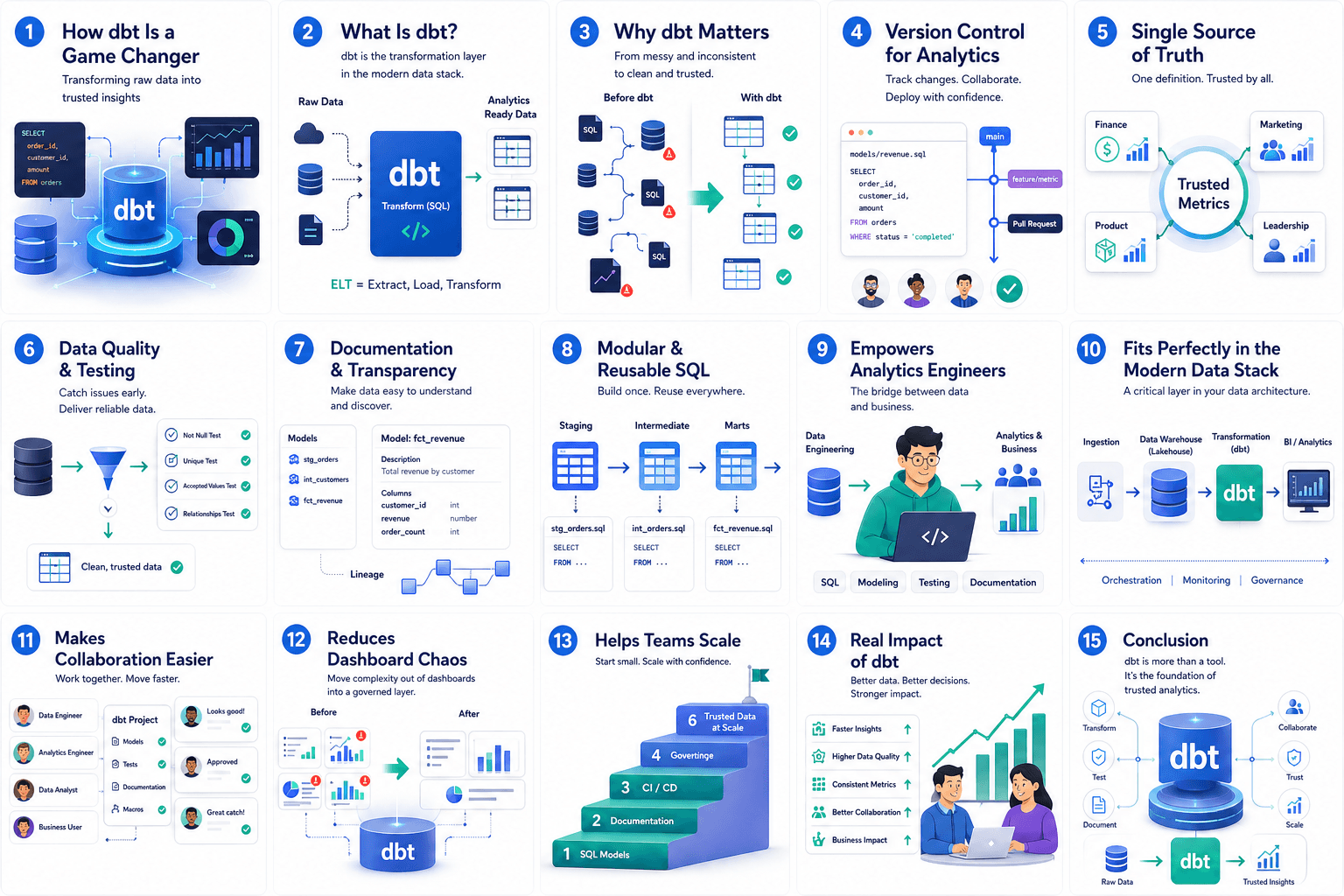
How dbt Is a Game Changer for Modern Data Teams
Data teams are under constant pressure to deliver clean, reliable, and business-ready data faster than ever. Companies want dashboards they can trust, metrics that are consistent, and data pipelines that do not break every time the business changes.
That is where dbt, short for data build tool, has become a game changer.
dbt has changed the way analysts, analytics engineers, and data teams transform raw data into trusted insights. Instead of treating data transformation as a hidden, fragile process owned only by engineering teams, dbt brings software engineering discipline into analytics.
What Is dbt?
dbt is a transformation tool used in the modern data stack. It helps teams take raw data from a warehouse or lakehouse and turn it into clean, modeled, analytics-ready datasets.
In simple terms, dbt lets teams write SQL, organize it into reusable models, test the data, document it, and version-control the entire workflow.
It does not usually extract or load data. Instead, it focuses on the “T” in ELT: transforming data after it has landed in the warehouse.
Why dbt Matters
Before dbt, many data teams struggled with messy SQL scripts, undocumented business logic, duplicated metrics, and unreliable dashboards. One analyst might define revenue one way, while another team defines it differently. Over time, this creates confusion and mistrust.
dbt solves this by creating a structured, transparent, and collaborative way to manage data transformations.
It turns SQL work into a proper engineering workflow.
1. dbt Brings Version Control to Analytics
One of the biggest advantages of dbt is that it works well with Git.
This means every change to a data model can be tracked, reviewed, and rolled back when needed. Instead of analysts editing SQL directly inside BI tools or running disconnected scripts, teams can collaborate through pull requests, code reviews, and deployment workflows.
This is a major shift.
Data transformation becomes less like ad hoc reporting and more like professional software development.
2. It Creates a Single Source of Truth
Every business depends on core metrics: revenue, active users, churn, conversion rate, customer lifetime value, and more.
Without a controlled transformation layer, these metrics often get recreated in different tools by different people. That leads to inconsistent numbers and endless debates over which dashboard is correct.
dbt helps centralize business logic in one place.
When a revenue model is defined in dbt, downstream dashboards, reports, and analyses can all use the same trusted definition. This improves confidence in the data and reduces confusion across the company.
3. dbt Makes Data Quality Easier to Manage
Bad data can silently damage decision-making.
dbt includes built-in testing capabilities that allow teams to check whether important assumptions are true. For example, teams can test that a customer ID is never null, that an order ID is unique, or that a status field only contains approved values.
These tests help catch problems early before they reach dashboards or executive reports.
This is one of the biggest reasons dbt is so powerful: it makes data quality part of the workflow, not an afterthought.
4. It Improves Documentation and Transparency
In many companies, data knowledge lives in people’s heads. Someone knows what a table means, why a column exists, or how a metric is calculated, but that knowledge is rarely documented properly.
dbt helps solve this with built-in documentation.
Teams can document models, columns, relationships, and business definitions directly alongside the code. dbt can also generate documentation sites that make it easier for analysts, engineers, and business users to understand the data.
This reduces dependency on tribal knowledge and makes onboarding much easier.
5. dbt Supports Modular, Reusable SQL
Traditional SQL workflows often become long, complex, and difficult to maintain. dbt encourages teams to break transformations into smaller, reusable models.
Instead of writing one huge query that does everything, teams can create clear layers such as staging models, intermediate models, and final marts.
This makes pipelines easier to read, debug, and scale.
A well-structured dbt project also allows teams to reuse logic rather than copying and pasting SQL across multiple reports.
6. It Empowers Analytics Engineers
dbt played a major role in popularizing the role of the analytics engineer.
Analytics engineers sit between data engineers and analysts. They understand business logic, write SQL, build trusted datasets, and apply engineering best practices to analytics work.
dbt gives analytics engineers the tools they need to build reliable data products. It allows them to move fast while still maintaining quality, governance, and documentation.
7. dbt Fits Perfectly into the Modern Data Stack
Modern companies often use cloud data warehouses such as Snowflake, BigQuery, Databricks, or Redshift. dbt works well with these platforms and complements tools used for ingestion, orchestration, BI, and reverse ETL.
Because dbt sits in the transformation layer, it becomes the place where raw data is converted into meaningful business entities like customers, orders, subscriptions, invoices, and product usage.
This makes it a central part of the modern analytics architecture.
8. It Makes Collaboration Easier
Data work is no longer limited to one person or one team. Analysts, engineers, product teams, finance teams, and leadership all depend on shared data.
dbt makes collaboration easier by giving teams a common workflow.
Everyone can see how models are built, how metrics are defined, and how different tables connect. Changes can be reviewed before they go live. Documentation can be shared. Tests can be automated.
This creates a culture of trust and accountability around data.
9. It Reduces Dashboard Chaos
Many organizations suffer from dashboard overload. There may be dozens of dashboards showing slightly different numbers for the same metric.
dbt helps reduce this chaos by moving business logic out of dashboards and into a governed data transformation layer.
BI tools should be used mainly for visualization and exploration. dbt handles the logic behind the scenes, making sure dashboards are powered by clean and consistent data.
10. dbt Helps Teams Scale
As companies grow, data complexity grows with them. More sources, more users, more reports, and more business questions all increase pressure on the data team.
dbt helps teams scale by making transformation workflows maintainable.
A small team can start with simple SQL models. Over time, they can add tests, documentation, modular structures, CI/CD, environments, and governance practices. This gradual maturity makes dbt useful for startups as well as large enterprises.
The Real Impact of dbt
The real value of dbt is not only technical. It changes how organizations think about data.
It helps teams move from scattered SQL and inconsistent reports to a disciplined, transparent, and trusted analytics foundation.
With dbt, data teams can:
Build reliable datasets faster
Reduce manual errors
Improve trust in reporting
Standardize business metrics
Collaborate through version control
Document data assets clearly
Catch quality issues before users see them
Scale analytics without creating chaos
Conclusion
dbt is a game changer because it brings structure, trust, and engineering discipline to the analytics world.
It allows data teams to transform raw data into reliable business insights using familiar SQL, while also adding testing, documentation, version control, and collaboration.
In a world where every company wants to be data-driven, dbt helps make that goal realistic. It does not just improve data pipelines; it improves how teams work with data.
That is why dbt has become one of the most important tools in the modern data stack.