Closing the Gap Between Data and Decisions.
Apr 6, 2026
Closing the Gap Between Data and Decisions.
Your data stack cost you millions. Your dashboards are beautiful. So why is your leadership team still running on instinct — and what’s the real price of that gap?
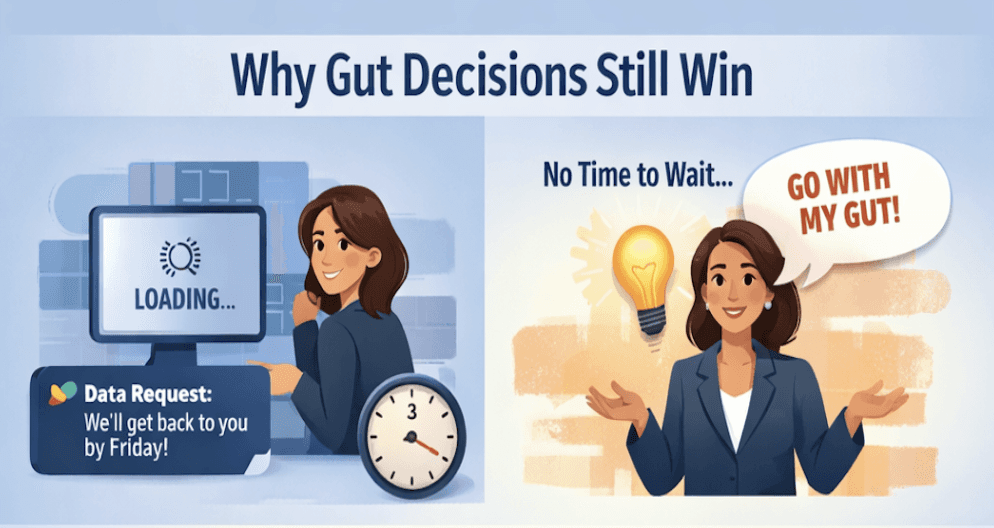
Picture your VP of Customer Success on a Tuesday afternoon. She has a quarterly business review in four hours. She needs to know which accounts are at risk, what’s driving churn in the enterprise segment, and whether the new onboarding flow is actually working.
She opens your BI tool. She waits for a dashboard to load. She finds a report that’s close — but not quite right. She sends a Slack message to the data team. They’re slammed. She’ll hear back by end of week.
So she does what every smart, experienced executive does when the clock is ticking: she goes with her Instincts.
This is happening in your company right now. Maybe dozens of times a day. And the cost isn’t just a few bad calls — it’s a slow, quiet erosion of the competitive edge you thought you were buying when you invested in data infrastructure.
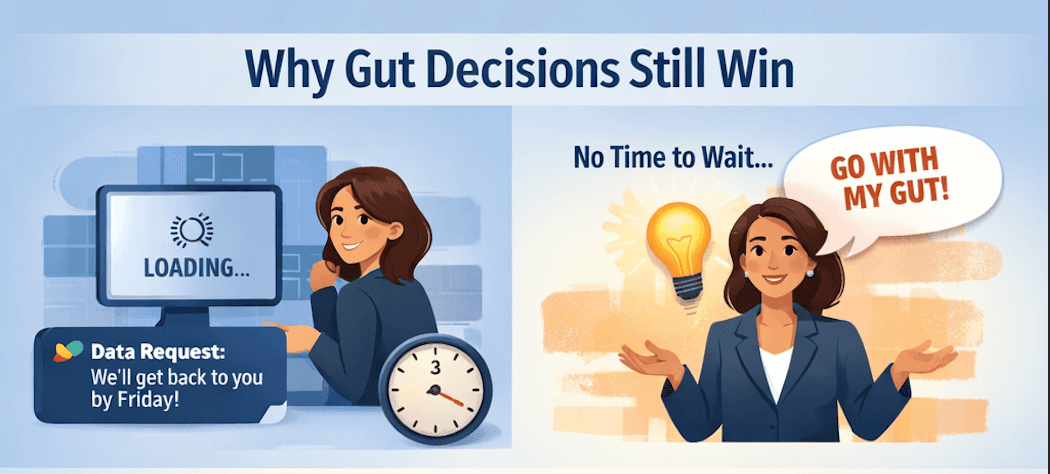
74% of executives say they make most decisions without the data they need | $3.1M average annual cost of poor data access at a 500-person SaaS company | 12% of BI tool licenses are actively used weekly by business users |
The data paradox hiding in your P&L
Here’s the contradiction that should keep you up at night. Most Series B+ SaaS companies have spent between $500K and $5M building a modern data stack. The works: cloud warehouses, transformation pipelines, ingestion tools, visualization layers. Your data engineers are talented. Your pipelines are clean. Your warehouse is well-modeled.
And yet, your business users — the people making the calls that actually move your revenue number — aren’t using any of it.
This isn’t a laziness problem. It’s an access problem. The people who need data most are the furthest from it. Every time a head of sales needs to reforecast, every time a VP of product needs to prioritize a roadmap, every time a CFO needs to model a scenario — they have to go through a person or a tool they weren’t trained to use. The data exists. The insight doesn’t.
“The problem isn’t that your company doesn’t have data. It’s that your data is locked behind tools designed for analysts — not the people who need to act on it.”
What Instincts decisions actually cost you
Let’s make this concrete. The costs show up in three places most leaders don’t look.
Opportunity cost from slow decisions. When your Head of Growth spends three days waiting on a segmentation analysis before launching a campaign, you didn’t just delay — you lost the window. Markets move. Competitors don’t wait. A company that can answer a business question in 20 minutes versus three days isn’t just faster; it’s playing a fundamentally different game.
REAL-WORLD SCENARIO A 400-person SaaS company estimated that decision latency — the gap between needing an insight and getting it — was costing them roughly 2–3 weeks per quarter in delayed campaigns, slow renewals responses, and missed pricing adjustments. At their growth rate, that delay translated to $1.8M in deferred revenue annually. |
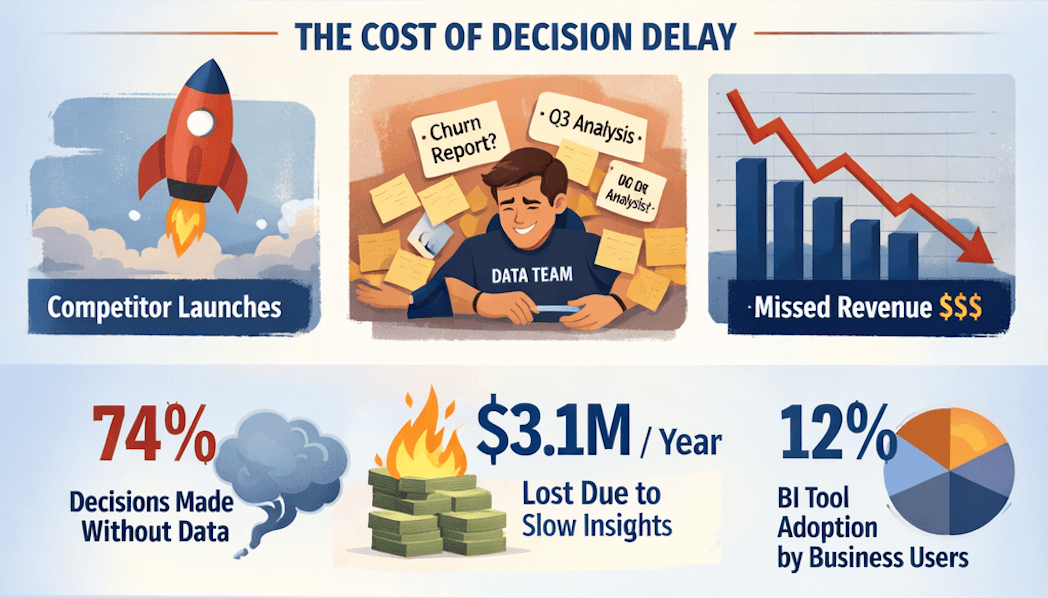
The hidden tax on your data team. Your analysts and data engineers are among the most expensive people in your building. When they spend 60% of their time fielding ad hoc questions from business users — “Can you pull the churn rate by segment?” “What did Q3 look like?” — they’re not doing the strategic work you hired them for. You’re paying senior talent to be a human query interface.
Confidence debt that compounds over time. When leaders make Instincts calls and they work, Instincts calls get reinforced. Intuition starts substituting for evidence. Over time, you build a culture where data is for reporting, not deciding — and reversing that culture is one of the hardest things a CDO will ever do.
Why the tools you bought didn’t fix this
Most BI tools were built for analysts. The assumption baked into them is that someone technically fluent will sit down, explore the data, build a view, and share it upward. That workflow made sense in 2012. It doesn’t fit how modern SaaS organizations actually operate.
Your business leaders don’t want to learn a new interface. They don’t want to drag and drop dimensions. They want to ask a question — in plain language, on their timeline — and get a trustworthy answer. The gap between what most BI tools were designed for and what your business users actually need is where Instincts decisions are born.
THE ADOPTION MATH
If you’re paying $150K/year for a BI platform and only 12% of licensed users are actively querying it each week, your effective cost-per-insight is 8× what you think it is. That’s before accounting for the decisions that didn’t get made because the right person didn’t have the right data.
The shift that changes everything
The companies pulling ahead aren’t buying more BI tools. They’re rethinking who gets to ask questions of their data — and how.
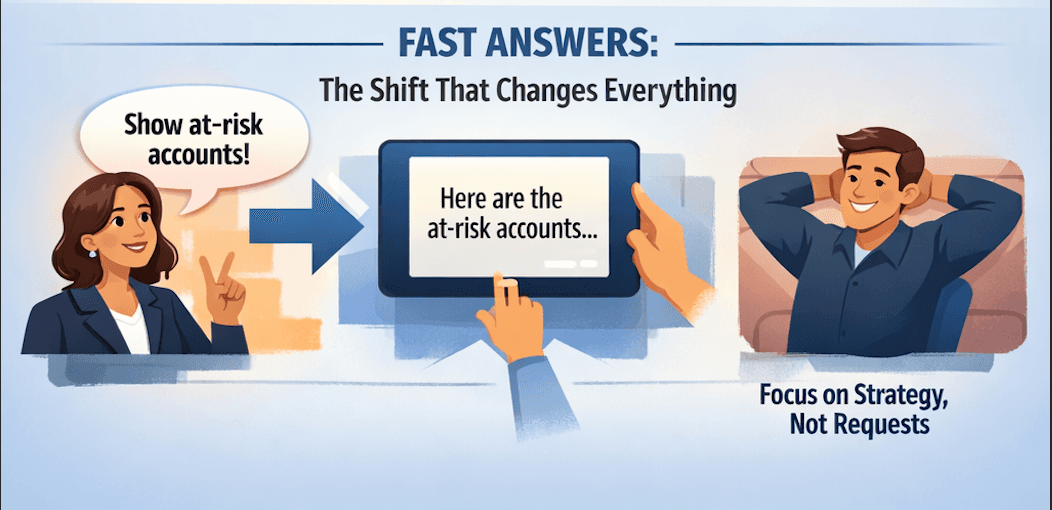
The most impactful change a data leader can make right now is collapsing the distance between a business question and a business answer. That means moving from a world where insights flow through a small team of technical specialists to a world where any VP, any head of function, any account executive can surface the exact context they need — without a ticket, without a dashboard, without waiting.
Companies that have made this shift report outcomes that look almost implausible until you understand the mechanism: 80% faster time-to-insight for business users, 40% reduction in ad hoc data requests to the analytics team, and — critically — measurable improvements in decision quality because people are actually using evidence instead of instinct.
Business leaders ask questions in plain language and get answers in seconds, not days
Data engineers focus on modeling and infrastructure, not fielding one-off requests
Decisions get made faster, with evidence — not after the window closes
BI tool adoption goes from 12% to 70%+ because the interface matches how people actually think
A data-driven culture builds itself organically, because using data is now easier than not using it
What to Ask Your Team This Week
You don’t need to blow up your data stack to start addressing this. Start by auditing the decision latency in your organization. Ask your direct reports: in the last 30 days, how many times did you need data to make a call, and how long did it take to get it? The answers will tell you everything.
Then ask: how many of those times did you just go with your Instincts because waiting wasn’t an option?
That number — quiet, invisible, never on a dashboard — is the real cost of your data strategy.
What to do about it: a practical path forward
The good news is this is a solvable problem — and you don’t need to blow up your data stack to fix it. The companies closing this gap are doing four things differently.
1. Build a governed semantic layer your whole organisation can trust
The root cause of Instincts decisions isn’t a missing dashboard — it’s that business users don’t trust or can’t access a single source of truth. Invest in a semantic layer that defines your key metrics once — ARR, NRR, churn, CAC — and makes them available consistently to every tool and every team. When the CFO and CRO see the same number, the conversation shifts from “whose data is right” to “what do we do about it.”
2. Bring natural language querying to your existing warehouse
You don’t need to replace your data infrastructure. You need to add a natural language interface on top of it — one that lets your VP of Sales ask “which enterprise accounts haven’t expanded in 90 days?” and get a reliable answer without a ticket or a training session. AI-powered query tools that sit on top of your existing warehouse can reduce time-to-insight from days to under two minutes, with zero change to your underlying data model.
3. Embed data access where decisions actually happen
The reason business users don’t go to the BI tool is that the BI tool is somewhere else. Integrate data access directly into the tools your leaders already live in — Slack, your CRM, your CS platform. When a head of renewals can pull a health score without leaving the account they’re looking at, usage follows automatically. Meet people where they are, not where your data team works.
4. Shift your data team’s mandate from reactive to proactive
Freeing analysts from ad hoc requests isn’t just a cost win — it’s a strategic one. When your data team isn’t firefighting, they can proactively surface anomalies, model scenarios, and build the decision-support tools that create real competitive advantage. Define a clear charter: analysts own insight architecture, not the help desk.
WHAT THIS LOOKS LIKE IN PRACTICE
One Series C SaaS company implemented a natural language analytics layer on top of their existing warehouse in under six weeks. Within 90 days, ad hoc data requests to the analytics team dropped by 43%. Their Head of Growth was running her own segmentation analyses in under three minutes. The data team shipped two new predictive models that quarter — work that had been backlogged for eight months.